
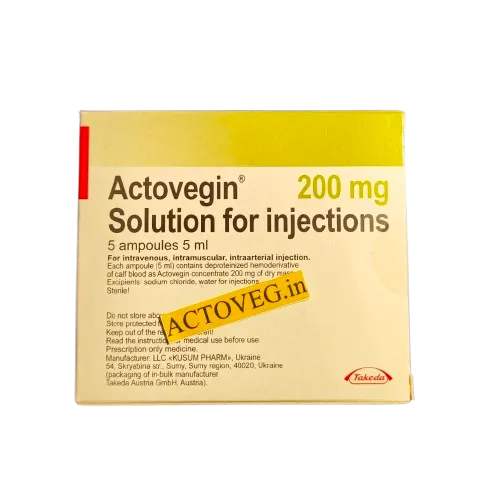
Actovegin 200 mg Injection, 5 ml (5 Ampoules)
Actovegin 200 mg in 5 ml ampoules is a parenteral dosage form supplied as a solution for injection and/or infusion,
depending on local registration. The active substance is a deproteinized hemoderivative obtained from calf blood.
This formulation is used in clinical practice when a clinician prescribes parenteral metabolic support therapy,
including situations where controlled dosing and supervised administration are required.
This informational leaflet provides a structured overview of Actovegin 200 mg (5 ml ampoules), including pharmaceutical
characteristics, clinical use, administration principles, safety considerations, and storage guidance.
Pharmaceutical Form and Strength
- Dosage form: Solution for injection and/or infusion (market-dependent labeling)
- Strength per ampoule: 200 mg
- Ampoule volume: 5 ml
- Concentration (calculated): 40 mg/ml
- Pack size: 5 ampoules
- Active substance: Deproteinized hemoderivative from calf blood
The active substance is obtained through multistage filtration designed to remove high-molecular proteins,
resulting in a complex mixture of low-molecular components. Excipients may vary by jurisdiction and manufacturer;
always consult the package leaflet for the exact composition.
Pharmacological Properties
Actovegin is described as a metabolic agent with antihypoxic properties. The proposed pharmacological profile is
associated with enhanced cellular uptake and utilization of oxygen and glucose, supporting energy metabolism
in tissues under hypoxic or ischemic stress.
Because the active substance is biological-derived and multifactorial, the mechanism is commonly presented as a combined
metabolic and microcirculatory support effect rather than a single-target pharmacological action.
Indications for Use
Indications may differ across countries and official product documentation. In clinical labeling, injectable Actovegin is used
in treatment protocols for conditions associated with impaired circulation and tissue trophism, where parenteral therapy is
considered appropriate by a clinician. Commonly listed indications include:
- Cerebral circulatory and metabolic disorders (including recovery phases after ischemic events, traumatic brain injury sequelae)
- Peripheral circulation disorders and trophic disturbances
- Diabetic polyneuropathy (in selected treatment protocols)
The 5 ml ampoule format is often used for standard parenteral dosing steps within a prescribed regimen.
The dose, route, and duration depend on diagnosis, severity, comorbidities, and clinical response.
Route of Administration
Actovegin 200 mg (5 ml) is intended for parenteral use. Depending on local instructions and the prescribing plan,
administration may involve:
- Intravenous (IV) injection (slow administration under professional supervision)
- Intravenous (IV) infusion after appropriate dilution (as specified by local instructions)
- Intramuscular (IM) injection in selected cases, consistent with clinical guidance and volume limitations
Parenteral therapy should be performed by qualified medical personnel. Medical supervision is particularly important at treatment
initiation because hypersensitivity reactions may occur.
Dosage Principles
Dosage and duration of therapy are determined individually by a healthcare professional. General principles often include:
- Initiation under medical supervision with monitoring for hypersensitivity
- Use of IV infusion/injection in acute or intensive phases when prescribed
- Potential transition to oral Actovegin tablets as continuation therapy, where clinically appropriate
Patients should not alter the regimen independently. Any adjustments should be made only by a prescribing clinician.
Contraindications
Actovegin should not be used in patients with known hypersensitivity to the active substance or any excipients. Because contraindications
and warnings may be jurisdiction-dependent, the package leaflet for the specific product batch should be considered the primary reference.
Warnings and Precautions
- Hypersensitivity: Allergic reactions are possible. Administration should be stopped immediately if symptoms develop.
- Fluid and electrolyte status: Patients with fluid retention or electrolyte imbalance may require clinical monitoring.
- Comorbidities: Inform the clinician about cardiac, renal, or pulmonary disease and all ongoing therapies.
If signs of hypersensitivity occur (rash, urticaria, facial swelling, wheezing, sudden weakness, hypotension), administration must be stopped
and emergency medical management initiated.
Use During Pregnancy and Breastfeeding
Use during pregnancy or breastfeeding should only occur under medical supervision and after an individualized benefit–risk assessment.
Parenteral therapy in these settings requires particular caution and should follow local prescribing guidance.
Possible Side Effects
The most clinically significant concern for injectable formulations is hypersensitivity. Potential adverse reactions include:
- Allergic skin reactions (rash, itching, urticaria)
- Flushing, sensation of warmth
- Rarely, severe hypersensitivity reactions including angioedema or anaphylactoid reactions
- Local injection-site reactions depending on route (pain, redness)
Any suspected adverse reaction should be reported to a healthcare professional. Severe or rapidly progressive symptoms require urgent medical attention.
Drug Interactions
Patients should inform the clinician of all medicines and supplements in use. Specific interaction patterns may not be emphasized in standard leaflets,
but safe clinical practice requires review of concomitant therapy, particularly in complex neurological or vascular treatment plans.
Storage and Handling
- Store ampoules according to the temperature and light-protection instructions printed on the packaging
- Do not use if the solution appears discolored, contains particles, or the ampoule is damaged
- Single-use only: An opened ampoule must not be stored for later use
- Keep out of the reach of children
Clinical Use Considerations
The 5 ml ampoule is commonly used as part of structured parenteral regimens where injectable/infusion administration is required,
followed by oral continuation therapy when appropriate. The treatment plan depends on diagnosis and clinical response and is defined by a clinician.
Summary
Actovegin 200 mg injection solution in 5 ml ampoules is a parenteral formulation used in clinical practice to support metabolic processes and tissue trophism
in conditions associated with impaired circulation. Administration should be performed under professional supervision with attention to hypersensitivity risk,
comorbidities, and local prescribing instructions.