$71.00
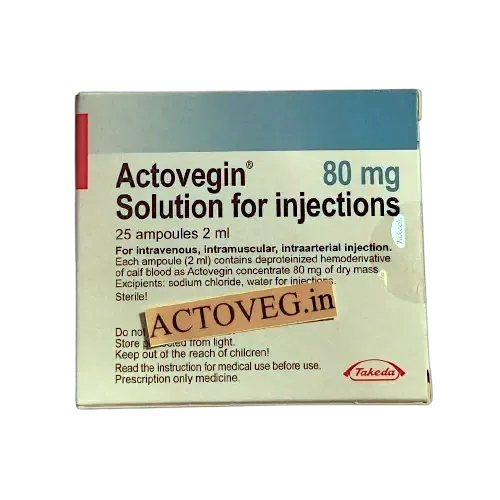
Actovegin is a medication that stimulates metabolic and regenerative processes in the body’s tissues. Each dosage is 2 ml, and it comes in packages of 25 vials.
Description
ACTOVEGIN® 80 mg, 2 ml – Solution for Injection (25 ampoules)
INN: Actovegin
Therapeutic Category: Antihypoxant, tissue regeneration stimulator
Form: Injectable solution for intravenous, intramuscular, or intraarterial use
Dosage: 80 mg/2 ml deproteinized hemoderivative of calf blood
Packing: 25 ampoules × 2 ml, in tamper-evident box with instructions
Manufacturer: Takeda Pharmaceuticals International AG (Austria/Japan)
Composition
- Active ingredient: deproteinized hemoderivative of calf blood – 80 mg/2 ml
- Excipients: sodium chloride, water for injection
Description
Clear, colorless to slightly yellow solution in glass ampoules. No visible particles. pH 6.8–7.8. Osmolarity approx. 300 mOsm/kg.
Pharmacological Action
Actovegin enhances cellular energy metabolism, increases oxygen and glucose uptake, and facilitates ATP production. It exhibits anti-hypoxic, neuroprotective, and microcirculatory actions by improving mitochondrial function, increasing endothelial nitric oxide synthesis, and reducing oxidative stress.
Onset of action is observed within 30 minutes post-administration; peak effects occur in 2–3 hours.
Indications
- Vascular disorders (arterial/venous insufficiency, angiopathy, trophic ulcers)
- Diabetic polyneuropathy (DPN)
- Brain ischemia, dementia, traumatic brain injury
- Radiation damage (cutaneous/mucosal)
- Wound healing post skin graft or severe burns
Dosage & Administration
- Initial therapy: 10–20 ml IV or IA daily
- Maintenance: 5 ml IV slowly or IM daily or 3–4 times weekly
- Infusions: 10–50 ml Actovegin in 200–300 ml saline or 5% glucose; max infusion rate 2 ml/min
- Use sterile filters (≥15 micron); administer ampoule content immediately after opening
Specific Indications
- Stroke/Cognitive Impairment: 250–500 ml/day IV for 2 weeks, then 250 ml IV 2–3×/week for 4+ weeks
- DPN: 2000 mg/day IV for 3 weeks, followed by tablets 3×3/day for 4–5 months
- Ulcers/Burns: 10 ml IV or 5 ml IM daily, with topical Actovegin
Use in Sports
Actovegin 80 mg, 2 ml ampoules are widely used in sports medicine to support tissue recovery and reduce downtime after injuries. Athletes report faster regeneration of muscles, tendons, and ligaments due to Actovegin’s ability to enhance cellular oxygen uptake and glucose metabolism. These effects are especially beneficial in high-intensity training or post-traumatic phases, where rapid tissue repair is critical.
Clinical data suggest Actovegin improves microcirculation and reduces oxidative stress by modulating inflammatory pathways (e.g., NF-κB) and supporting mitochondrial efficiency. In professional sports, intramuscular administration has been associated with shortened return-to-play intervals after soft tissue injuries. While not performance-enhancing per se, its therapeutic use for recovery is well-documented and generally considered safe when used under medical supervision.
Contraindications
- Hypersensitivity
- Pulmonary edema, oliguria, anuria
- Fluid overload, uncompensated heart failure
Adverse Effects
Rare: hypersensitivity (rash, urticaria); very rare: angioedema, anaphylaxis. No overdose reports in humans.
Clinical Evidence
- ARTEMIDA trial (503 patients post-stroke): cognitive improvement over 6 months – ADAS‑Cog+ reduction –6.8 vs –4.6 (p=0.005) – PMID 28432265
- 2022 Meta-analysis: Potential stroke recurrence risk, unclear net benefit – PMID 35771887
- Review of mitochondrial, antioxidative, and anti-apoptotic effects – PMID 32365943
- Animal study: improved glucose utilization, no toxicity – PMID 37913525
Patient Advice
- Do not exceed IV rate (5 ml/day IM or 2 ml/min IV)
- Finish treatment course even if symptoms improve
- Alert physician at any allergic symptoms
- Pregnancy/lactation use only under supervision
Storage
Store at ≤25 °C in original packaging. Do not use if solution is cloudy or contains particulates. Use immediately after opening ampoule. Keep away from children.
Shelf Life
36 months from date of manufacture.